

Global
Trump warns of second US military strike on Venezuela after Maduro’s capture
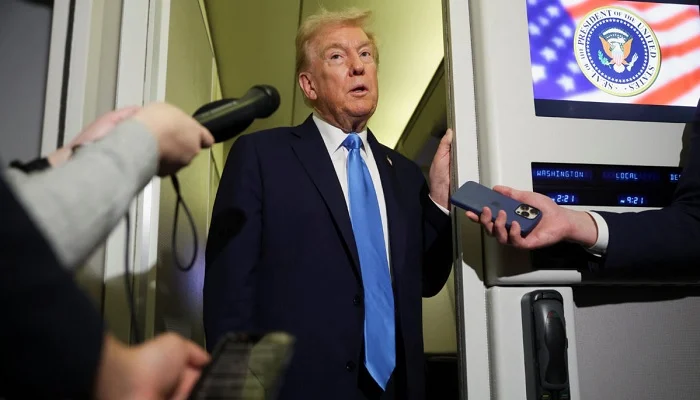
WASHINGTON: US President Donald Trump on Sunday warned that the United States could launch a second military strike on Venezuela following the capture of President Nicolás Maduro, saying further action could be taken if remaining members of the Maduro administration do not cooperate with Washington’s efforts to “fix” the country.
Speaking to reporters aboard Air Force One, Trump suggested that US military interventions in Latin America could expand, hinting that Colombia and Mexico might also face action if they fail to curb the flow of illicit drugs into the United States. “Operation Colombia sounds good to me,” he said, while also claiming that Cuba, a close ally of Venezuela, “looks like it’s ready to fall” without US military involvement.
Maduro is currently being held at a detention centre in New York and is scheduled to appear in court on Monday on US drug-related charges. His capture has plunged the oil-rich South American nation into deep political uncertainty.
Trump said his administration would work with remaining elements of the Maduro government to crack down on drug trafficking and overhaul Venezuela’s oil sector, rather than pushing immediately for elections. Senior officials in Caracas, however, rejected that stance, calling the detention of Maduro and his wife, Cilia Flores, a kidnapping.
“There is only one president, and his name is Nicolás Maduro Moros,” Interior Minister Diosdado Cabello said in an audio message released by the ruling socialist party, urging supporters not to fall for what he termed “enemy provocations.”
Images of the 63-year-old Maduro blindfolded and handcuffed stunned many Venezuelans. The operation marked Washington’s most controversial intervention in Latin America since the 1989 invasion of Panama. Venezuela’s Defence Minister General Vladimir Padrino said the US attack killed soldiers and civilians and wiped out a large part of Maduro’s security detail “in cold blood,” adding that the armed forces had been activated to defend national sovereignty. Cuba said 32 of its citizens were killed during the raid.
Vice President Delcy Rodríguez has assumed the role of interim leader with the backing of Venezuela’s top court, though she maintains that Maduro remains president. While Trump has claimed Rodríguez is willing to work with Washington, she has publicly rejected that assertion. Trump later warned she could “pay a higher price” if she failed to cooperate.
The Trump administration has described Maduro’s capture as a law-enforcement operation linked to criminal charges filed in 2020, including narco-terrorism conspiracy, which Maduro denies. Trump, however, also stressed the importance of US oil companies gaining “total access” to Venezuela’s vast reserves, and blamed Maduro for sending millions of migrants, including criminals, into the United States.
Venezuelan officials accused Washington of seeking control over the country’s natural resources. “In the end everything was revealed — they only want our oil,” Cabello said.
Read More: Pakistan and China reaffirm zero tolerance for terrorism, pledge deeper security cooperation
US Secretary of State Marco Rubio said Venezuela’s future leadership must keep the oil industry out of the hands of US adversaries and halt drug trafficking, citing an ongoing blockade on tankers. He said Venezuela’s economy would not recover until conditions aligned with US and Venezuelan interests.
On the streets of Caracas, some Maduro supporters staged government-backed rallies, while others carried on cautiously with daily life amid uncertainty. Bakeries and cafes reopened, and residents stocked up on essentials, reflecting a mix of fear and resilience.
Opposition figures reacted cautiously. Trump dismissed opposition leader Maria Corina Machado as lacking sufficient support, despite her claims that her ally won the disputed 2024 election.
Internationally, questions mounted over the legality of detaining a foreign head of state. The UN Security Council is set to meet on Monday to discuss the US action, while Russia and China, both key allies of Venezuela, have strongly criticised Washington.