

Global
Iran orders start of nuclear talks with US amid rising tensions
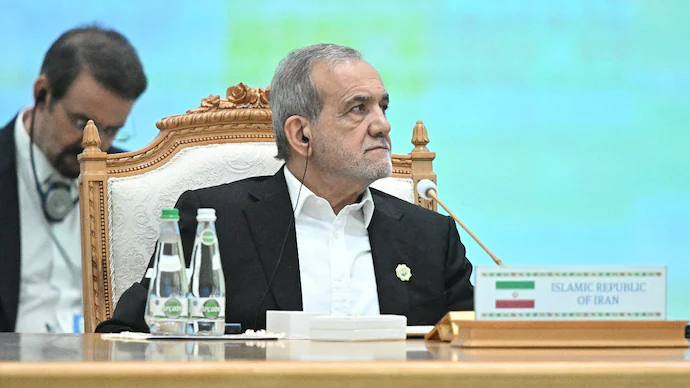
TEHRAN: Iranian President Masoud Pezeshkian has ordered the opening of nuclear talks with the United States, local media reported on Monday, as US President Donald Trump said he was hopeful of reaching a deal to avert military action against the Islamic republic.
The development comes amid heightened tensions following Iran’s response to anti-government protests that peaked last month, after which Trump warned of possible military action and ordered the deployment of an aircraft carrier group to the Middle East.
Despite escalating pressure, Trump has maintained that he remains hopeful of a diplomatic solution, while Tehran has reiterated its preference for talks, warning it would respond forcefully to any aggression.
“President Pezeshkian has ordered the opening of talks with the United States,” news agency Fars reported, citing an unnamed government source. The agency said the two sides would hold talks on the nuclear file, without announcing a timeline. The report was also carried by the government daily Iran and reformist newspaper Shargh.
Earlier on Monday, Iran said it was working on a framework and mechanism for negotiations, with details expected to be finalised in the coming days. Messages between Tehran and Washington are being conveyed through regional intermediaries.
“Several points have been addressed and we are examining and finalising the details of each stage in the diplomatic process, which we hope to conclude in the coming days,” Foreign Ministry spokesman Esmaeil Baqaei said, without elaborating.
Trump has warned that “time is running out” for Iran to reach an agreement over its nuclear programme, which Western powers believe is aimed at developing an atomic weapon. Tehran has repeatedly denied seeking nuclear arms.
Baqaei said Iran “never accepts ultimatums” and added he could not confirm whether any formal warning had been conveyed by Washington.
Regional states have pushed for diplomacy to ease tensions. Iranian Foreign Minister Abbas Araghchi recently visited Turkey and held calls with counterparts in Egypt, Saudi Arabia and Turkey, according to a statement posted on Telegram.
“President Trump said no nuclear weapons, and we fully agree,” Araghchi told CNN on Sunday. “That could be a very good deal. Of course, in return, we expect sanctions lifting.”
Baqaei said the support of neighbouring countries for diplomacy reflected concerns that any US attack on Iran could destabilise the region, echoing Supreme Leader Ayatollah Ali Khamenei’s warning that such an action would trigger a “regional war”.
Read More: PM Shehbaz meets KP CM Afridi to discuss security, governance issues
Ambassadors summoned
Khamenei has described last month’s protests as an attempted “coup”, while authorities said the demonstrations were fuelled by foreign adversaries, including the United States and Israel.
Iran has acknowledged thousands of deaths during the unrest. On Sunday, the presidency published the names of 2,986 people from a total of 3,117 deaths reported by authorities, saying most were security personnel and civilians, while blaming the violence on “terrorist acts”.
The crackdown led the European Union to designate the Islamic Revolutionary Guard Corps as a terrorist organisation. Iranian lawmakers responded by applying the same label to European armies.
Baqaei said on Monday that Iran had summoned ambassadors from EU member states in Tehran over the designation, warning that further responses would follow.
Iranian state television also reported the arrest of four foreigners in Tehran for alleged involvement in the protests, without disclosing their nationalities. Rights groups estimate that at least 40,000 people have been detained since the unrest began.