

Global
China announces 7% increase in defence spending for 2026
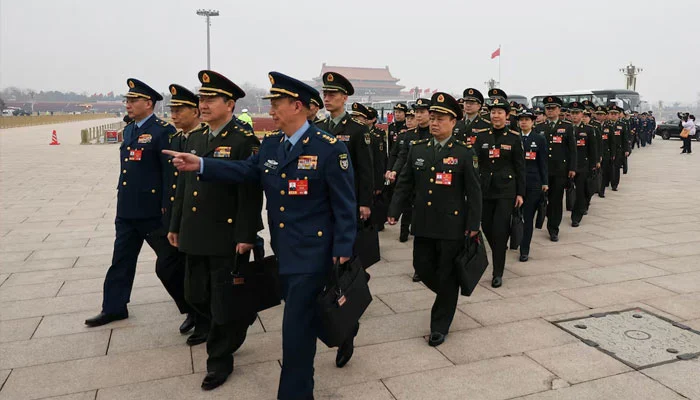
ISLAMABAD: China announced on Thursday that it will increase its defence spending by 7% in 2026, the lowest annual rise in five years but still higher than the country’s broader economic growth targets and military spending trends across Asia.
The announcement came during the opening session of the annual parliament meeting, where Chinese Premier Li Qiang presented the government’s work report outlining key policy priorities and economic goals.
Beijing also set a gross domestic product growth target between 4.5% and 5% for the coming year.
Speaking at the session, Li said China would enhance combat readiness and accelerate the development of advanced military capabilities to strengthen national defence.
“All these steps will boost our strategic capacity to safeguard China’s sovereignty, security, and development interests,” he said, adding that President Xi Jinping holds ultimate command responsibility over the armed forces.
The 7% rise follows three consecutive years of increases of around 7.2% and marks the lowest growth in military spending since 2021, when it stood at 6.8%.
China’s defence budget is part of a long-term effort to modernise the People’s Liberation Army by 2035. The military has in recent years developed advanced missiles, warships, submarines and surveillance technologies.
Security analysts say Beijing continues to balance economic growth with national defence priorities.
James Char of Singapore’s S. Rajaratnam School of International Studies said the defence budget has historically grown at a rate close to the country’s GDP growth plus inflation.
The spending increase comes amid a major anti-corruption campaign within China’s military leadership.
Two senior generals have faced disciplinary investigations in recent months, including Zhang Youxia, a close military ally of Xi, who was reportedly placed under investigation earlier this year.
Another senior officer, He Weidong, was expelled last year as part of the ongoing crackdown.
Following the purge, only two members remain from the typical seven-member leadership of the Central Military Commission — Xi Jinping as chairman and recently promoted vice chairman Zhang Shengmin.
Analysts say the corruption investigations indicate Beijing’s intention to maintain tighter oversight of defence spending and military operations.
Meanwhile, China reiterated its stance on Taiwan, which Beijing considers part of its territory.
Li said China would “resolutely fight against separatist forces aimed at Taiwan independence” and oppose external interference, while promoting peaceful cross-strait relations and the goal of national reunification.
Taiwan’s government responded cautiously, saying it had not observed any major shift in Beijing’s policy but remained concerned about the scale of China’s military spending.
A spokesperson for Taiwan’s Mainland Affairs Council said the increase in defence expenditure posed a potential threat to the island, especially as it comes despite challenges facing China’s domestic economy.
Regional governments are also closely monitoring China’s military expansion.
Read More: Fake notification about suspension of Pakistan port entries debunked
In Japan, Chief Cabinet Secretary Minoru Kihara said Beijing was not sufficiently transparent about its defence spending and growing military capabilities.
According to a recent report by the London-based International Institute for Strategic Studies, China’s share of Asia’s total military expenditure rose to nearly 44% in 2025, compared with an average of 37% between 2010 and 2020.
China’s defence budget for 2026 is expected to reach around 1.91 trillion yuan (approximately $277 billion), still significantly lower than the roughly $1 trillion defence budget signed into law by Donald Trump in the United States last year.