

Global
Former Chinese Premier Zhu Rongji dies at 98
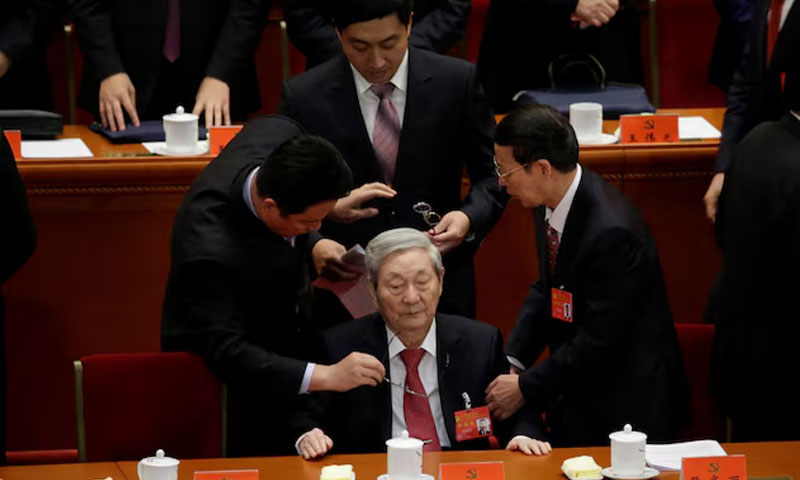
BEIJING: Former Chinese Premier Zhu Rongji died at the age of 98 in Beijing on Wednesday, state-run Xinhua news agency reported.
Zhu, who served as China’s vice premier from 1991 to 1998 and premier from 1998 until early 2003, became widely known for his blunt speeches, economic reforms and efforts to modernise China’s state-dominated economy.
A four-volume collection of his speeches published in 2011 drew widespread attention, particularly for his unusually direct criticism of corruption, poor governance and economic mismanagement. His remarks describing poorly built flood-control infrastructure as “tofu dregs” and referring to erring bankers as “half-wits” became widely discussed.
The publication of more than 2,000 pages of his speeches also revived debate among Chinese reformists and intellectuals over the country’s economic direction as China prepared for a leadership transition that eventually brought Xi Jinping to power.
Many of the issues highlighted by Zhu remained significant challenges for China, including local government debt, reckless bank lending, inflation, rapid urbanisation and corruption.
In a speech in 1998, Zhu warned that China faced potential crises and said public dissatisfaction was being fuelled by corruption among officials, the widening gap between rich and poor and the conduct of some local officials.
Zhu was born in 1928 and graduated from Tsinghua University in Beijing. He joined the Communist Party in 1949, the year Mao Zedong established the People’s Republic of China.
During the Cultural Revolution, Zhu was sent to work in the countryside. After his political rehabilitation, he gradually rose through the party and government ranks and was appointed mayor of Shanghai in 1987.
Read More: 11 killed as wedding party rickshaw plunges into canal in Kot Addu
As Shanghai mayor, he oversaw the city during the early stages of its transformation into one of the world’s major financial and commercial centres.
Zhu moved to Beijing in 1991 to join the central government, where he became a leading figure in efforts to restructure China’s economy.
As vice premier and later premier, he helped tackle economic overheating in the early 1990s and pushed through major reforms of state-owned enterprises. His policies resulted in the closure or privatisation of many state firms and large-scale layoffs.
He also worked to strengthen the central government’s control over tax revenues and introduced housing reforms that contributed to the rapid expansion of private home ownership and China’s property market.
One of his most significant achievements was helping secure China’s entry into the World Trade Organization in 2001, following years of difficult negotiations. China formally joined the WTO in December 2001.
Zhu’s reform agenda was not without critics. Some observers argued that policies involving grain production, tax distribution and the restructuring of state-owned enterprises created problems that later governments had to address.
Former senior People’s Daily editor Zhou Ruijin said in a 2011 interview that Zhu’s tenure had promoted major reforms and encouraged a generation of officials willing to take risks in developing a market-oriented economy.
Zhu left office in early 2003, but his legacy continued to shape debates over economic reform, governance and China’s transition from a centrally planned economy toward a market-driven model.