

Global
Tarique Rahman Steps Into Spotlight After BNP Election Sweep
DHAKA: Long overshadowed by his parents and born into one of Bangladesh’s most influential political dynasties, BNP leader Tarique Rahman has now emerged as the central figure in the country’s shifting political landscape.
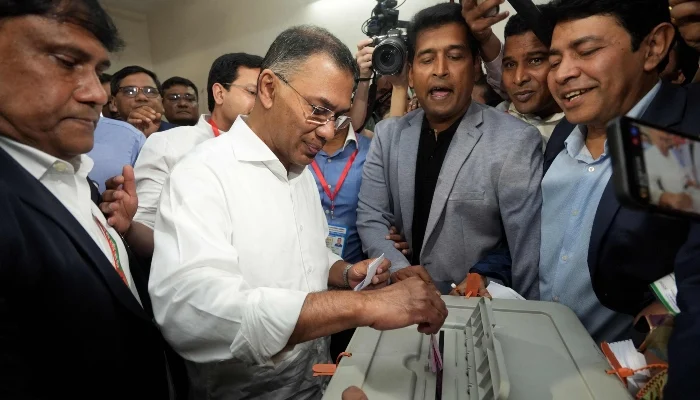
At 60, Rahman is preparing to take charge of the South Asian nation of around 170 million people after the Bangladesh Nationalist Party claimed a sweeping victory in parliamentary elections held on Thursday. While official results are still awaited, the United States has already congratulated Rahman on what it described as a “historic” win.
Rahman’s rise marks a dramatic turnaround for a leader who only returned to Bangladesh in December after spending 17 years in exile in Britain, far from Dhaka’s intense political rivalries. Widely known as Tarique Zia, he carries a family legacy that has shaped every stage of his life.
He was just 15 when his father, President Ziaur Rahman, was assassinated in 1981. His mother, Khaleda Zia — a three-time prime minister and one of Bangladesh’s most dominant political figures — died in December shortly after his return home.
Speaking days before the election, Rahman said he intended to honour their legacy while forging his own path.
“They are them, I am me,” he said, adding that he would try to “do better” than his parents. He described returning home as a moment of joy quickly overtaken by grief, as he was unable to embrace his mother before her death.
Soon after arriving in Dhaka, Rahman assumed leadership of the BNP and led its election campaign, rallying massive crowds while still mourning.
Bangladesh’s politics have long been defined by rivalry between the Zia family and the dynasty of Sheikh Mujibur Rahman, whose daughter Sheikh Hasina ruled for years before being toppled in a deadly uprising. That rivalry entrenched decades of alternating power between Khaleda Zia and Hasina.
Rahman’s political career, however, has also been clouded by allegations of corruption and abuse of authority. Arrested in 2007, he claims he was tortured in custody before fleeing to London in 2008. He has repeatedly denied wrongdoing, calling the charges politically motivated, though he acknowledged offering an apology for any “unwanted mistakes.”
Read More: BNP Secures Two-Thirds Majority in Bangladesh Elections
After Hasina’s fall, Rahman was acquitted of the most serious accusation against him — a life sentence linked to a 2004 grenade attack — which he has always denied.
In Britain, he lived a quiet life with his family, but that changed dramatically with his return to Bangladesh, where he received a hero’s welcome. Social media was also flooded with images of his ginger cat, Jebu, accompanying him home.
Rahman has admitted the challenges ahead are immense, saying he must rebuild a country he believes was “destroyed” under the former regime, as Bangladesh enters a new political chapter.