

Global
Tulsi Gabbard flags Pakistan’s missile programme as potential concern
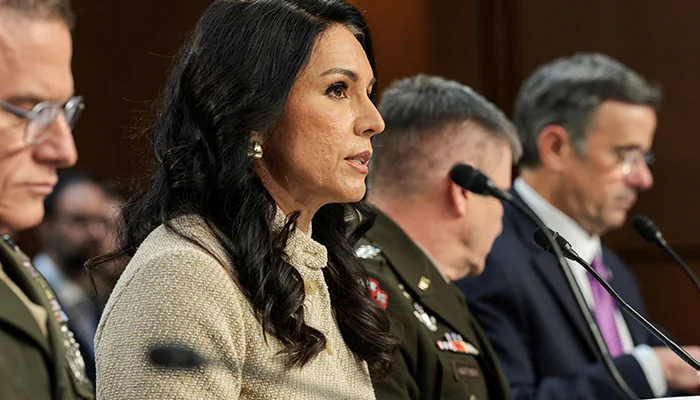
WASHINGTON: United States Director of National Intelligence Tulsi Gabbard has identified Pakistan among countries posing a growing strategic concern, warning that its evolving long-range missile capabilities could potentially bring the American homeland within range.
Presenting the 2026 Annual Threat Assessment before the Senate Intelligence Committee, Gabbard named Pakistan alongside Russia, China, Iran and North Korea as nations developing advanced missile delivery systems with both nuclear and conventional payloads.
“The US secure nuclear deterrent continues to ensure safety in the homeland against strategic threats. However, Russia, China, North Korea, Iran and Pakistan have been researching and developing an array of novel, advanced, or traditional missile delivery systems… that put our homeland within range,” she said.
She added that Pakistan’s ballistic missile development “potentially could include intercontinental ballistic missiles (ICBMs)” capable of reaching the United States. The report also projected that global missile inventories could exceed 16,000 by 2035, up from more than 3,000 currently.
Read More: Outbound flights drop sharply amid regional tensions linked to Iran conflict
Reacting to the remarks, former Pakistani ambassador to the US Jalil Abbas Jilani rejected the claim, saying Pakistan does not pose a direct missile threat to the American homeland. He emphasised that Islamabad’s nuclear doctrine is India-centric and aimed at deterrence rather than global power projection.
Meanwhile, Turkish analyst Shaqeq-ud-Din also questioned the assessment, arguing that Pakistan does not possess intercontinental ballistic missiles and raising concerns over India’s expanding capabilities. He described the classification of threats as selective and called for uniform scrutiny of all countries.
The report further highlighted South Asia as a region of “enduring security challenges,” particularly tensions between Pakistan and India, noting the risk of escalation between the two nuclear-armed neighbours. It referenced past conflicts, including the recent crisis triggered by the Pahalgam attack, warning that such incidents could again act as catalysts for conflict.
It also noted that intervention by former US president Donald Trump helped de-escalate recent tensions, while assessing that neither Pakistan nor India currently seeks open conflict, despite the presence of conditions that could trigger crises.
Additionally, the report pointed to strained relations between Pakistan and Afghanistan, citing intermittent cross-border clashes and Islamabad’s concerns over militant groups operating from Afghan territory. It noted that Pakistan has urged the Afghan Taliban to sever ties with such groups, while the Taliban has denied harbouring anti-Pakistan militants and called for dialogue.