

Pakistan
Dar warns UN Security Council of global risks from prolonged Middle East conflict
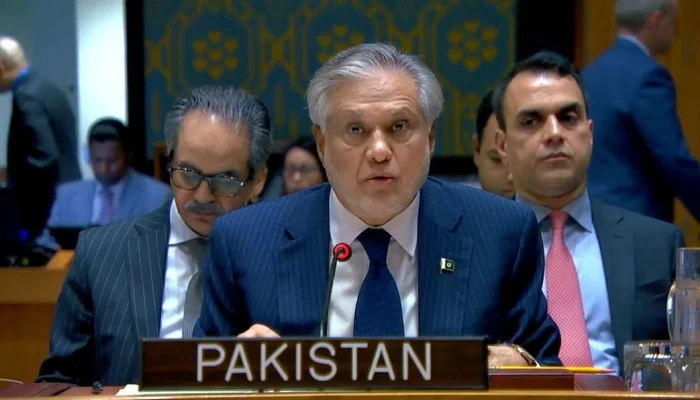
UNITED NATIONS: Deputy Prime Minister and Foreign Minister Ishaq Dar on Tuesday warned that prolonged conflict in the Middle East could threaten global stability and the wider international order, urging renewed focus on diplomacy and peaceful dispute resolution.
Addressing an open debate of the United Nations Security Council on the maintenance of international peace and security, Dar said Pakistan has consistently supported dialogue, negotiation and the principle of self-determination in resolving disputes.
“Diplomacy is not weakness,” he said, stressing that negotiations must remain the first line of action for sustaining peace.
Dar noted that Pakistan, China and other partners were actively engaging in efforts to promote stability in the Gulf and broader Middle East, warning that continued instability could disrupt global energy flows and weaken the international system.
He also highlighted Pakistan’s ongoing efforts to ensure the security of key maritime routes and waterways critical to global trade.
The deputy prime minister drew attention to longstanding unresolved disputes, including Kashmir, stating that the issue has remained on the agenda of the United Nations for nearly eight decades despite Security Council resolutions.
He said sustainable peace in South Asia could not be achieved through unilateral actions or coercion, adding that India’s suspension of the Indus Waters Treaty posed risks to regional stability.
On the Palestine issue, Dar reaffirmed Pakistan’s position supporting the right to self-determination for the Palestinian people and criticised occupation policies and settlement expansion, saying they undermine prospects for lasting peace.
Read More: Sindh tightens Ebola screening at Karachi airport amid global outbreak fears
He also criticised what he described as the selective application of international law, saying global confidence in multilateral institutions weakens when principles are applied inconsistently across different conflicts.
“When sovereignty is defended in one case but disregarded in another, the Charter is weakened,” he said, calling for consistency in upholding international law.
Dar reiterated Pakistan’s support for reforms in the United Nations system, saying changes should improve representation for developing countries rather than concentrate power among a few states.
He described the UN as an indispensable institution that requires renewed commitment to its founding principles and Charter to remain effective in addressing global challenges.