

Global
Xi and Putin signal stronger China–Russia alignment
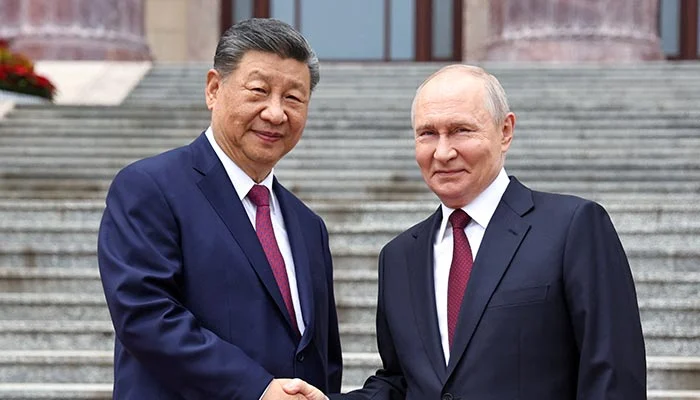
BEIJING: Xi Jinping and Vladimir Putin on Wednesday reaffirmed what they described as “unyielding” bilateral ties, as both leaders met in Beijing to reinforce their strategic partnership amid shifting global geopolitics.
The meeting at Beijing’s Great Hall of the People came days after a visit by Donald Trump to China, which ended without major breakthroughs on issues including energy cooperation and Middle East tensions.
Putin’s visit is taking place against the backdrop of prolonged Western sanctions on Russia over the war in Ukraine, which have significantly reduced Moscow’s access to Western markets and increased its reliance on Chinese demand for energy exports.
China has emerged as Russia’s largest buyer of crude oil, while both sides have expanded cooperation in trade, technology, and energy infrastructure.
Xi told Putin that bilateral relations had “continuously deepened political mutual trust and strategic coordination with a resilience that remains unyielding,” according to Chinese state media.
Putin responded that relations had reached an “unprecedentedly high level,” despite what he described as “unfavourable external factors.”
Analysts say discussions may include progress on the proposed Power of Siberia 2 pipeline, a major natural gas project designed to supply Russian energy to China through Mongolia, reducing reliance on maritime energy routes from the Middle East.
The project is seen as strategically significant as global energy markets remain volatile due to instability in the Gulf region and disruptions affecting shipping routes such as the Strait of Hormuz.
Xi also criticised what he described as “unilateral and hegemonic countercurrents,” widely interpreted as a reference to the United States.
Read More: Sana Yousaf murder case: Court sentences main accused to death
Beijing and Moscow have significantly strengthened ties since Russia’s 2022 invasion of Ukraine, with Putin visiting China regularly as Moscow faces isolation from Western economies.
Despite presenting itself as neutral on the Ukraine war, China has not condemned Russia’s military actions, instead calling for diplomatic negotiations.
While both countries share strategic alignment, analysts note differences in their approach to Middle East instability.
Russia has sought to benefit from rising energy prices caused by disruptions in the region, while China has called for de-escalation to ensure stability in global trade routes.
Xi stressed that further escalation in the Middle East was “inadvisable” and called for an immediate ceasefire, reflecting Beijing’s dependence on stable maritime trade routes for energy imports and commerce.
The talks underscore how evolving global conflicts—from Ukraine to the Middle East—are reshaping alliances among major powers and intensifying competition over energy security and trade corridors.