

Pakistan
PM Shehbaz says shared water resources must not be weaponised
BISHKEK: Prime Minister Shehbaz Sharif on Tuesday said shared water resources must never be used as a weapon or an instrument of political coercion, calling for international agreements governing transboundary waters to be honoured unconditionally.
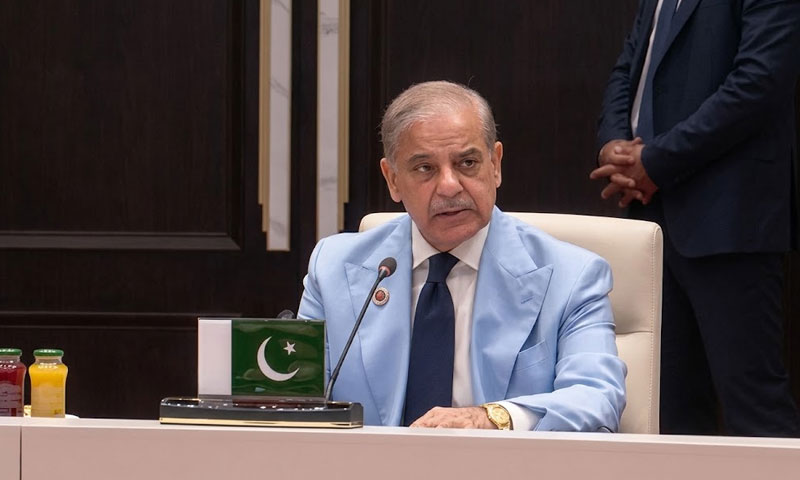
Addressing the 26th meeting of the Shanghai Cooperation Organisation (SCO) Council of Heads of State in Bishkek, Shehbaz described water as the lifeblood of the region and stressed that it could not be exploited for political leverage.
“Water is the lifeblood of our region,” the prime minister said, adding that it sustained millions of lives, nourished lands and secured the future of coming generations.
Referring to agreements governing shared water resources, he said such arrangements were solemn and binding international commitments rather than matters of political convenience.
“They must be honoured unconditionally in both letter and spirit,” he said.
The remarks came amid heightened tensions over shared water resources, with Pakistan repeatedly calling for adherence to the Indus Waters Treaty with India.
Pakistan assumes SCO chairmanship
Pakistan formally assumed the SCO Council of Heads of State chairmanship for 2026-27, with Shehbaz saying Islamabad would use the coming year to promote regional cooperation and deliver tangible benefits for people across member states.
He said Pakistan’s priorities would include information technology and artificial intelligence, energy, development and poverty reduction, disaster management, health, culture and sports.
Shehbaz proposed an SCO Sovereign AI Infrastructure and Governance Framework to promote responsible and inclusive artificial intelligence development, strengthen digital sovereignty and ensure that no member state was left behind.
Pakistan will also host the Global Resilience Expo 2026-27 in Islamabad to strengthen regional cooperation on disaster management, early-warning systems and emergency response, he said.
The prime minister called for full implementation of the SCO Development Strategy through 2035 and described the establishment of an SCO Development Bank as a critical step towards achieving the bloc’s development objectives.
Pakistan will also continue its role as permanent chair of the SCO Special Working Group on Poverty Reduction, focusing on social protection and inclusive development across the region.
Shehbaz invited SCO participants to Islamabad in 2027 for the next edition of the SCO Plus meeting.
Connectivity, CPEC highlighted
The prime minister described regional connectivity as a strategic imperative and highlighted the China-Pakistan Economic Corridor (CPEC) as a gateway linking regional economies with the Arabian Sea.
He reaffirmed Pakistan’s commitment to advancing trans-regional railway and road projects as well as regional energy schemes.
Shehbaz said the SCO had significant potential to contribute to regional development at a time of geopolitical tensions, economic fragmentation, climate crises and rapid technological change.
He urged member states to respond to these challenges through greater cooperation and dialogue.
“Let history record that the SCO did not merely witness a changing world — we shaped it together,” he said, calling for cooperation over confrontation, dialogue over division and bridges over barriers.
Pakistan highlights diplomatic efforts
Shehbaz also highlighted Pakistan’s diplomatic efforts following the violation of the sovereignty and territorial integrity of an SCO member state earlier this year, which he said had triggered a major regional crisis and disrupted critical energy supply routes.
He said Pakistan had consistently acted as an honest and sincere mediator and facilitator, with its diplomatic efforts culminating in the signing of the Islamabad Memorandum of Understanding.
The MoU, he said, represented the most viable and enduring pathway to lasting peace in the region and provided a basis for all parties to pursue peace through dialogue and diplomacy.
Makkah defence agreement
The prime minister also referred to the recently signed trilateral Makkah Joint Defence Agreement between Pakistan, Saudi Arabia and Türkiye, describing it as an expression of a shared commitment to sovereignty, territorial integrity, collective security and regional peace.
He stressed that the agreement was fundamentally defensive in nature and was neither directed against any state nor intended to create confrontation or division.
Shehbaz said the agreement sent a message of unity and common resolve while supporting peace, progress and prosperity across the region.
He reiterated Pakistan’s commitment to resolving regional disputes peacefully through continued diplomatic engagement.
Terrorism remains major threat
Turning to security, Shehbaz said terrorism remained one of the gravest threats facing SCO member states and countries represented in the wider SCO Plus grouping.
Pakistan had lost more than 90,000 lives and suffered economic losses exceeding $150 billion over the past two and a half decades in its fight against terrorism, he said.
“Our nation has stood resolutely in combating terrorism, not just for ourselves but for the entire globe,” the prime minister said.
As chair of the SCO Regional Anti-Terrorist Structure (RATS), Pakistan had worked to strengthen regional counter-terrorism cooperation and combat terrorism, separatism and religious extremism.
He called for terrorism in all its forms and manifestations, including what he termed state terrorism, to be condemned in clear and unambiguous terms.
Shehbaz reiterated Pakistan’s position that lasting peace would remain elusive as long as militant groups continued to use Afghan territory to launch attacks against Pakistan and other neighbouring countries.
PM calls for action on Gaza
Turning to the Middle East, Shehbaz said the suffering of Palestinians in Gaza and the West Bank continued unabated, with families facing what he described as unimaginable hardship.
“The international community must act decisively, and now, to end the suffering of the innocent Palestinian people and uphold their inalienable right to self-determination,” he said.
He called on the international community to help Palestinians and other oppressed nations secure their fundamental right to self-determination.
Shehbaz seeks UN reform
Speaking about the international order, the prime minister called for reform of the United Nations, saying the organisation needed to become more accountable and responsive as the world moved towards a multipolar system.
He said Pakistan had remained committed to the UN Charter throughout its eight decades and would continue working to promote lasting peace.
Pakistan viewed the emergence of a multipolar world as an opportunity to build a more equitable, democratic and just international system, he said, while stressing that the UN was urgently in need of reform.
“As a non-permanent member of the UN Security Council, Pakistan has been actively contributing to global peacemaking over the past two years,” Shehbaz said.
He reaffirmed Pakistan’s commitment to the UN and SCO charters and said Islamabad would continue advocating peace, dialogue and respect for sovereignty and territorial integrity.
Read More: Heavy rain floods Rawalpindi, Islamabad as Nullah Lai crosses evacuation threshold
Joint declaration signed
Shehbaz thanked Kyrgyz President Sadyr Japarov for hosting the summit and for his country’s successful SCO chairmanship.
Pakistan formally assumed the SCO Council of Heads of State chairmanship for 2026-27, with Shehbaz signing the summit’s joint declaration on behalf of Pakistan.
The summit was attended by heads of state and government from SCO member countries as well as SCO Secretary General Nurlan Yermekbayev.
The meeting also provided an opportunity for Pakistan to pursue diplomatic engagement with Iran.
Earlier on Tuesday, Deputy Prime Minister and Foreign Minister Ishaq Dar met Iranian Foreign Minister Abbas Araghchi in Bishkek and discussed implementation of the June 2026 Islamabad MoU.
The two ministers agreed that sincere implementation of the agreement by both parties to the dispute was the only way forward, while stressing the importance of dialogue, diplomacy and regular communication, according to Pakistan’s Foreign Office.
Shehbaz, Pezeshkian discuss regional situation
Earlier, Shehbaz and Iranian President Masoud Pezeshkian discussed regional developments, bilateral relations and implementation of the Islamabad MoU during a meeting on the sidelines of the SCO summit.
The two leaders reaffirmed their commitment to strengthening Pakistan-Iran relations and emphasised implementation of agreements reached during Pezeshkian’s June visit to Pakistan.
Shehbaz reiterated Pakistan’s commitment to promoting peace and de-escalation in the region and highlighted the recent visit of Chief of Defence Forces Field Marshal Syed Asim Munir to Tehran.
He said Munir’s constructive engagements were expected to contribute to positive outcomes.
The prime minister stressed that restraint, tolerance and sustained diplomacy were essential for lasting regional stability and described continued dialogue under the Islamabad MoU as the only viable way towards durable peace.
Pezeshkian welcomed Pakistan’s diplomatic role and described Pakistan-Iran relations as rooted in shared history, culture and religion.
The two leaders also discussed regional connectivity and people-to-people contacts. Shehbaz invited Pezeshkian to visit Pakistan, while the Iranian president invited him to attend the Economic Cooperation Organisation summit in Tehran in December 2026.